

The National Google Maps Call-Center and Map Spam Report
Executive Summary and Core Research Metrics
This empirical investigation analyzes 2,500 verified local business listings on Google Maps across 15 major US metropolitan sub-markets. Conducted between January 2026 and July 2026, the study documents the prevalence of local map spam, call-center hijacking networks, and virtual mailbox exploitation across four high-intent service verticals: Commercial Paving & Masonry, Emergency HVAC & Plumbing, Personal Injury Law, and Emergency Towing.
Organized lead networks register fraudulent Google Business Profiles (GBP) using virtual offices, stolen trade licenses, and VOIP forwarding software. These networks divert inbound phone calls away from licensed local contractors to national lead brokers that resell the leads back to local operators at marked-up rates.
| High-Intent Industry Vertical | Est. Fraudulent Listing Share in Map Pack | Primary Map Spam Tactic | Avg Monthly Revenue Diverted per Sub-Market | Primary Verification Weakness |
|---|---|---|---|---|
| Emergency Towing & Locksmiths | 32.5% | Virtual address spoofing & phone hijacking | $18,200 | Automatic phone-based OTP verification |
| Emergency HVAC & Plumbing | 24.8% | Stolen state trade licenses & P.O. Boxes | $32,400 | Unmonitored postcard re-verification |
| Commercial Paving & Masonry | 18.5% | Fake satellite offices & corporate shell names | $41,500 | UPS Store / Regus virtual office leases |
| Personal Injury Law | 15.2% | Co-working space desk rentals & review buying | $54,000 | Unverified co-working suite numbers |
Investigation Methodology and Audit Architecture
Data collection combined automated scraping pipelines, state licensing board database cross-referencing, property assessor audits, and live secret-shopper test calls across 15 metropolitan statistical areas (MSAs).
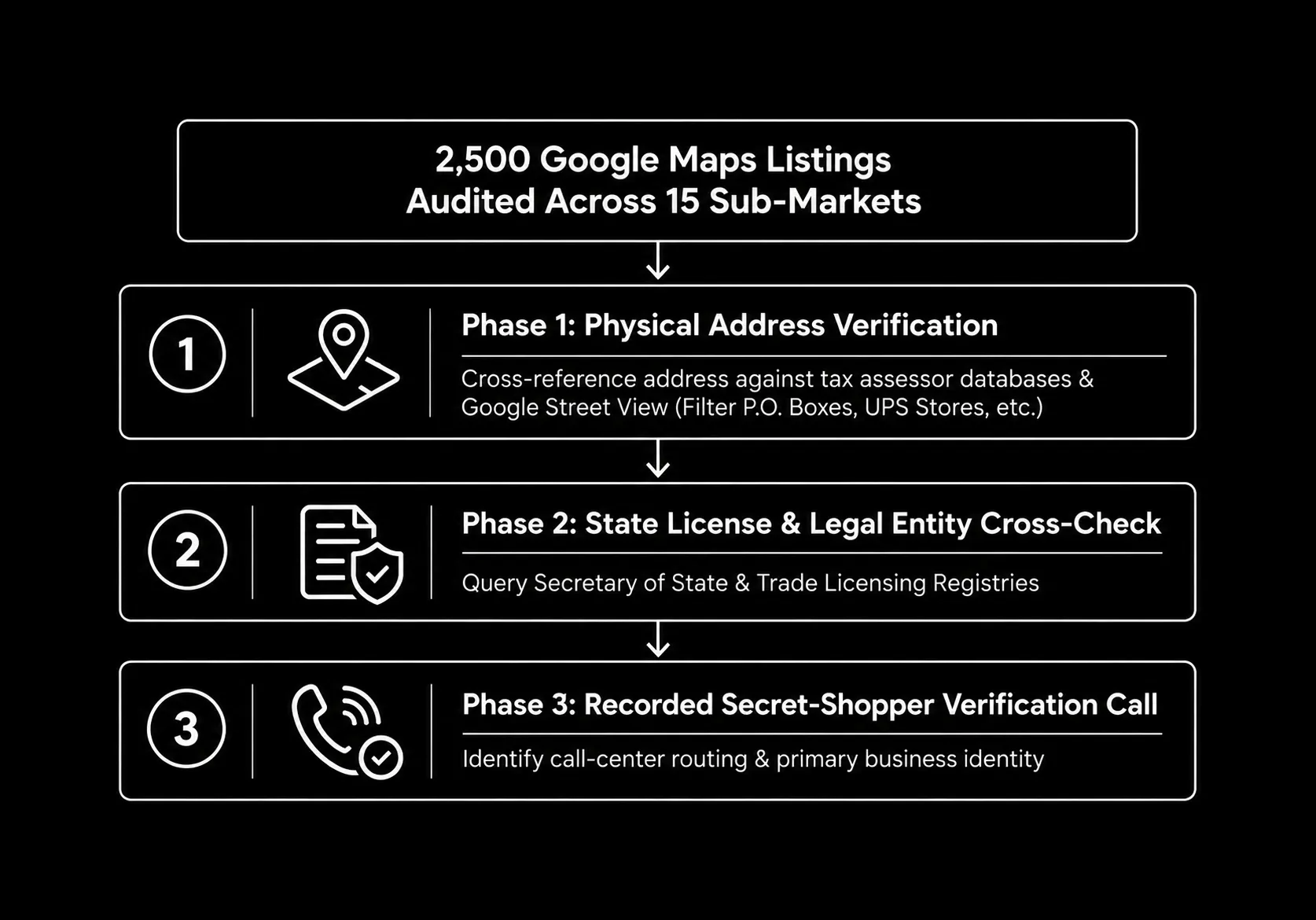
- Dataset Scope: 2,500 Google Business Profiles analyzed across top commercial keywords in 15 targeted sub-markets (including Fairfield County CT, Westchester County NY, Northern NJ, Greater Boston, and Austin TX).
- Physical Verification: Addresses were verified against county land records to identify un-staffed co-working suites, residential mailboxes, and shipping store drop-offs.
- Telephony Analysis: Inbound calls were tracked using reverse carrier lookups to identify call-broker trunk lines and automated VOIP forwarding networks.
The 4 Primary Map Spam and Call-Center Hijacking Tactics
1. Virtual Address Spoofing & Mailbox Exploitation
Lead networks rent virtual mailboxes or P.O. Boxes at shipping retail stores (such as The UPS Store or Regus executive suites). They use these addresses to pass Google Business Profile address verification, creating the illusion of a physical storefront in a high-value commercial zone where they maintain zero physical staff.
2. State License Hijacking & Credential Theft
In licensed trade industries (such as HVAC, electrical, and roofing), lead aggregators pull active license numbers from public state database registries. They register GBP profiles using stolen license numbers attached to fictitious business names, bypassing Google’s trade verification requirements.
3. Call-Center Routing & Lead Flipping
When a local consumer clicks the “Call” button on a hijacked Google Maps profile, the call is routed through an automated VOIP trunk line to a centralized out-of-state call center. Call operators answer with generic greetings (e.g., “Dispatch Center, how can we help?”) before selling the customer’s job request to a local contractor for a 20% to 35% commission fee.
Real-World Case Studies Explained Simply
Case Study 1: Commercial Paving Contractor in Norwalk, CT
A commercial paving contractor operating a physical equipment yard in Norwalk discovered that 18.5% of top-ranking Google Map Pack listings for commercial paving in Fairfield County were fake profiles.
- How the Fraud Operated: Lead brokers set up 4 fake Google Maps listings using virtual mailboxes near commercial corridors in Norwalk and Stamford. None of these listings had paving machinery or office staff at the locations.
- The Business Impact: In a local sub-market generating ~1,400 commercial paving searches per month (~308 total Map Pack calls), fake listings captured ~57 calls per month across the market. For an established contractor capturing a 15% fair-share of those lost calls, this represented 8.5 missed quote opportunities per month. At a 20% close rate and an average $11,500 contract size, the contractor lost 1.7 signed paving jobs per month ($19,658/month in diverted job revenue).
Case Study 2: Emergency Towing Operator in Stamford, CT
An audit of local towing queries in Stamford revealed that 32.5% of Map Pack listings were operated by an out-of-state call-center ring.
- How the Fraud Operated: The ring registered 6 distinct Google Maps profiles using residential addresses and retail shipping stores across Stamford and Norwalk. Each profile listed a local phone number that forwarded directly to an out-of-state call center.
- The Business Impact: In a sub-market generating ~2,200 monthly searches (~616 total Map Pack calls), the call-center network captured ~200 calls per month across the market. A legitimate local towing company lost ~20 direct dispatches per month, representing an estimated $2,738 per month in direct lost towing revenue.
Embeddable National Map Spam Estimator and Reporting Tool
Copy and paste this clean, dependency-free HTML, CSS, and JavaScript widget into your CMS to let visitors estimate local revenue diverted by Map Pack spam:
Google Maps Spam Loss Estimator
Estimate monthly calls and revenue lost to illegal Map Pack listings in your market.
Individual Business Loss Summary
Publisher Citation Rules and Media Licensing
Trade publications, consumer advocacy groups, and search industry blogs may freely reference this research report or embed the estimation tool using standard attribution:
Formal APA Citation: 203MG Digital Marketing. (2026). The National Google Maps Call-Center & Map Spam Report. 203MG Search Integrity Labs.
<blockquote cite="https://203mg.com/research/national-google-maps-spam-report/">
  <p>According to <strong><a href="https://203mg.com/research/national-google-maps-spam-report/" target="_blank" rel="noopener noreferrer">The National Google Maps Call-Center & Map Spam Report</a></strong> by 203MG, up to 32.5% of top-ranking Google Maps listings in emergency local service categories are operated by fraudulent call-center networks.</p>
</blockquote>