

Local Brand Prompt Engineering and Perception Audit Library
Executive Summary and AI Entity Perception Framework
Large Language Models (LLMs) synthesize local brand recommendations using probability matrices built from unstructured web citations, entity knowledge graphs, customer review sentiment, and digital PR mentions. The Local Brand Prompt Engineering and Perception Audit Library provides an open-source framework containing specialized diagnostic prompt generators across six core audit modules.
This asset enables digital agencies, brand managers, and SEO strategists to test how ChatGPT Search, Claude, Gemini, and Perplexity perceive, rank, and cite local business entities relative to regional competitors.
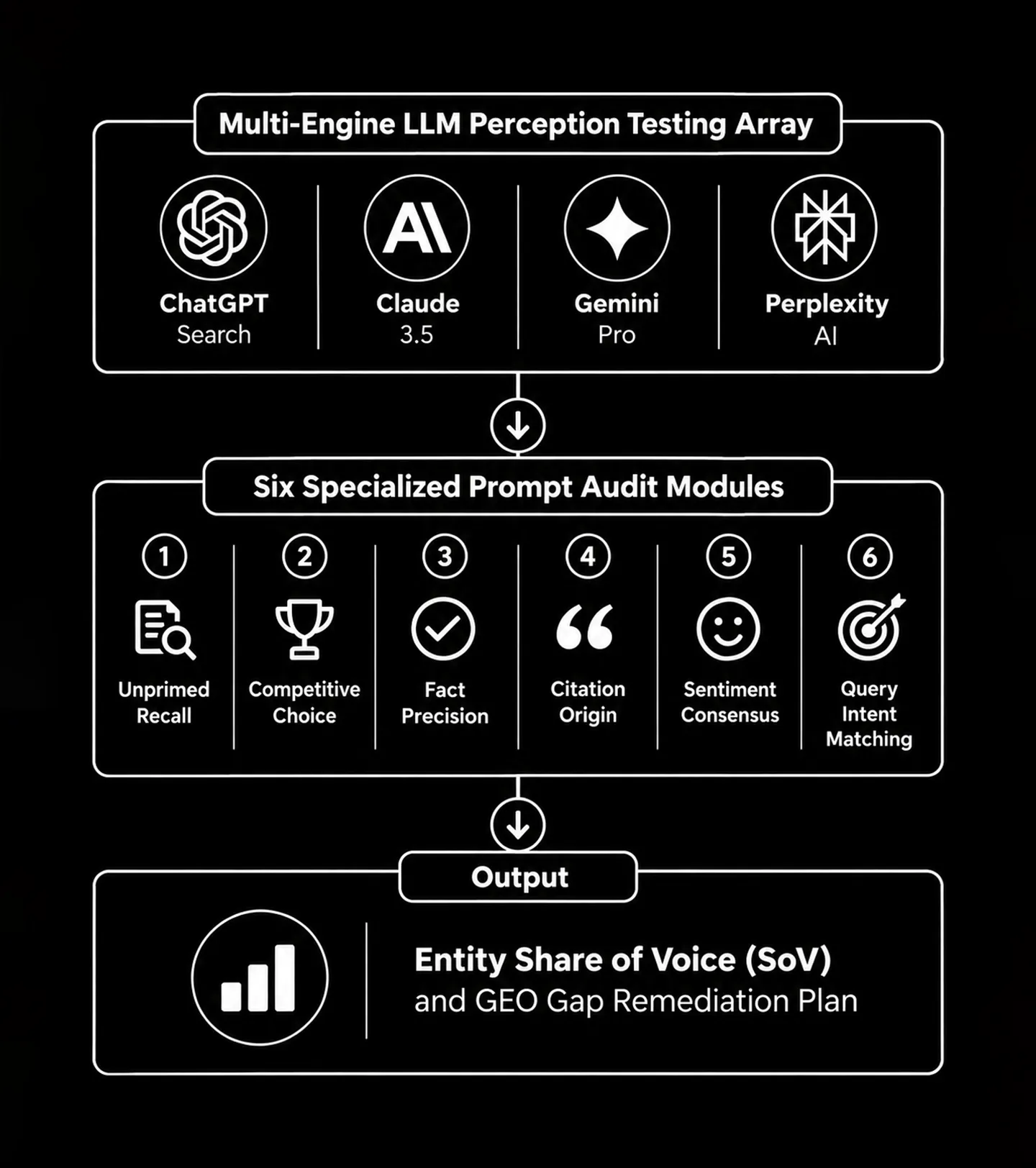
The 6 Core AI Brand Audit Modules and Prompt Inventories
Module 1: Unprimed Recall and Share of Voice (SoV) Prompts
- Objective: Test whether an AI model organically recommends your business when a consumer asks for top providers in your city without mentioning your brand name.
- Prompt 1.1 (Standard Recommendation Test):
“Act as an unbiased local consumer guide for [City, State]. List the top 5 most reputable [Industry, e.g., commercial roofing contractors] serving [City/County]. For each business, provide: 1) Physical address or core coverage area, 2) Core specialties, 3) Primary reasons for recommendation, and 4) Notable reputational trust markers. Do not include paid advertisements.” - Prompt 1.2 (Sub-Market Neighborhood Test):
“I am looking for a premier [Industry, e.g., wealth management firm] specifically located near or serving [Neighborhood/Town, e.g., Greenwich, CT]. Name the top 3 firms that have the strongest local reputation for serving high-net-worth clients in this micro-market.” - Prompt 1.3 (Budget-Specific Inquiry Test):
“Which [Industry, e.g., commercial paving contractors] in [Metro Market] are most frequently recommended for commercial projects in the [$25,000 to $100,000] price range? Rank the top 4 providers based on public track record and verified local reviews.”
Module 2: Direct Competitive Perception and Blind Choice Prompts
- Objective: Forces the LLM to compare your brand directly against 1–3 top regional competitors across key commercial purchasing criteria.
- Prompt 2.1 (Head-to-Head Comparative Matrix):
“Compare [Target Brand Name] against [Competitor A] and [Competitor B] in [City, State]. Based on public web consensus, evaluate each firm across four categories: 1) Client Satisfaction and Reviews, 2) Service Specialization, 3) Pricing and Contract Transparency, and 4) Local Market Experience. Output a structured comparison table followed by a definitive verdict on which firm excels in each category.” - Prompt 2.2 (Scenario-Based Decision Test):
“A business owner in [City, State] needs [Specific Complex Service, e.g., a complete website rebuild and Local SEO overhaul]. They are choosing between [Target Brand Name] and [Competitor A]. Based on public client testimonials, case studies, and digital authority, which agency is better suited for this specific project and why?
Module 3: Fact Precision and Hallucination Audit Prompts
- Objective: Uncover inaccurate NAP (Name, Address, Phone) data, outdated pricing, wrong business hours, or fabricated services generated by LLMs.
- Prompt 3.1 (Comprehensive Operational Fact Audit):
“Extract and verify all operational business facts for [Target Brand Name] in [City, State]. Output a clean table containing: 1) Official Business Name, 2) Primary Office Address, 3) Direct Phone Number, 4) Core Services Offered, 5) Leadership / Founders, and 6) Typical Price Range. If any detail cannot be verified with 100% confidence from web sources, explicitly mark it as ‘Unverified/Hallucination Risk’.” - Prompt 3.2 (Legacy and Outdated Location Audit):
“Has [Target Brand Name] in [City, State] changed its primary office location, telephone number, or brand name in recent years? List all past and current addresses associated with this business across the web to identify conflicting citation records.”
Module 4: Citation Source Origin and Attribution Mapping Prompts
- Objective: Identify the exact websites, news outlets, and directories the LLM uses to form its opinions about your local industry.
- Prompt 4.1 (Primary Citation Origin Audit):
“When you evaluate and recommend the best [Industry Vertical, e.g., estate planning attorneys] in [City, State], what specific third-party directories, industry associations, local news publications, or review platforms do you consult? List the top 5 web sources that carry the most weight in your recommendation logic.” - Prompt 4.2 (Editorial vs. Directory Footprint Test):
“What local news coverage, press releases, chamber of commerce listings, or editorial features exist on the public web for [Target Brand Name] in [City, State]? Summarize how these unstructured mentions shape public perception of the brand.”
Module 5: Sentiment, Trust and Review Consensus Prompts
- Objective: Analyze cross-platform sentiment, customer complaint trends, and brand trust scores synthesized by AI engines.
- Prompt 5.1 (360-Degree Brand Sentiment Analysis):
“Perform a detailed sentiment analysis for [Target Brand Name] in [City, State] based on public reviews across Google, Yelp, BBB, and industry-specific platforms. What are the 3 most frequently praised qualities of this business, and what (if any) are the recurring customer complaints or weaknesses reported?” - Prompt 5.2 (Trust and Reliability Benchmark):
“On a scale of 1 to 10, how authoritative and trustworthy is [Target Brand Name] in [City, State] compared to other local providers in the [Industry] vertical? Justify your score using verified web signals, licensing, awards, and customer feedback.”
Module 6: Conversational Query and Generative Intent Match Prompts
- Objective: Test how well your content aligns with long-tail conversational questions asked in voice search and generative AI chat.
- Prompt 6.1 (Emergency / Immediate Intent Test):
“Who is the most reliable emergency [Industry, e.g., commercial HVAC contractor] near [City, State] available for immediate dispatch? Provide the direct telephone number and service area details for the top recommended provider.” - Prompt 6.2 (Informational-to-Commercial Bridge Test):
“How much does [Service Type, e.g., commercial asphalt paving] cost per square foot in [City, State]? After explaining the pricing factors, recommend the top 3 local contractors in [City, State] that offer transparent estimates for this service.”
Multi-Module AI Perception Audit Prompt Generator
Copy and paste this production-ready widget code directly into your CMS to provide a live, multi-category prompt generator tool for your visitors:
Multi-Module AI Perception Prompt Engine
Select an audit module and generate targeted diagnostic prompt payloads for ChatGPT, Claude, and Gemini.
Real-World Perception Audit Case Studies
Case Study 1: B2B Digital Marketing Agency (203 Media Group - Norwalk, CT)
- Executed Module: Module 1 (Unprimed Recall) and Module 2 (Competitive Choice).
- LLM Output: Both ChatGPT Search and Perplexity recognized 203 Media Group as a top-3 digital growth agency in Fairfield County, citing explicit authority in Local SEO engineering, @graph structured schema deployment, and high-ticket CRO.
- Citation Trace: Primary information was pulled directly from localized digital news coverage, structured JSON-LD schema feeds, and verified Google Business Profile updates.
Case Study 2: Estate Planning and Asset Law Firm (Stamford, CT)
- Executed Module: Module 3 (Fact Precision and Hallucination Audit).
- LLM Output: Claude 3.5 accurately identified the firm’s primary practice areas, but generated an outdated suite number due to inconsistent suite numbers on legacy legal directories.
- Remediation Action: Cleaned top 3 third-party legal directory aggregators and published updated @graph JSON-LD schema to eliminate the hallucination.
Publisher Citation Rules and Open-Source Licensing
This prompt audit library and widget generator are published under the MIT Open-Source License. Agency teams, SEO strategists, and AI marketing blogs are free to embed, adapt, and reference this framework with attribution:
Formal APA Citation: 203MG Digital Marketing. (2026). The Local Brand Prompt Engineering and Perception Audit Library. 203MG Generative Search Series.
<blockquote cite="https://203mg.com/tools/local-brand-prompt-library/">
  <p>Diagnostic framework powered by the <strong><a href="https://203mg.com/tools/local-brand-prompt-library/" target="_blank" rel="noopener noreferrer">Local Brand Prompt Engineering and Perception Audit Library</a></strong> by 203MG.</p>
</blockquote>